
Table of Contents
ToggleIntroduction to Predictive Maintenance (PdM)
In the rapidly evolving landscape of Industry 4.0, the methodology of how we maintain industrial assets has undergone a seismic shift. Traditionally, maintenance was seen as a necessary evil—a reactive response to equipment failure or a rigid schedule of “just in case” checks. However, as we move through 2026, the gold standard has become Predictive Maintenance (PdM).
At its core, the predictive maintenance definition refers to a data-driven approach that monitors the condition and performance of equipment during normal operation. By utilizing a combination of predictive maintenance sensors and advanced analytics, organizations can identify potential failures before they occur. This transition from “fixing” to “foreseeing” represents the pinnacle of industrial AI applications, allowing businesses to move away from guesswork and toward precision.
The goal is simple yet profound: to perform maintenance at the exact moment it is needed, thereby maximizing the useful life of components while preventing the catastrophic costs of unplanned downtime.
How Does Predictive Maintenance Work?
Predictive maintenance is not a single tool but a sophisticated ecosystem of hardware and software working in harmony. It relies on the continuous flow of data from the shop floor to the cloud.
The Role of IoT Sensors and Data Collection
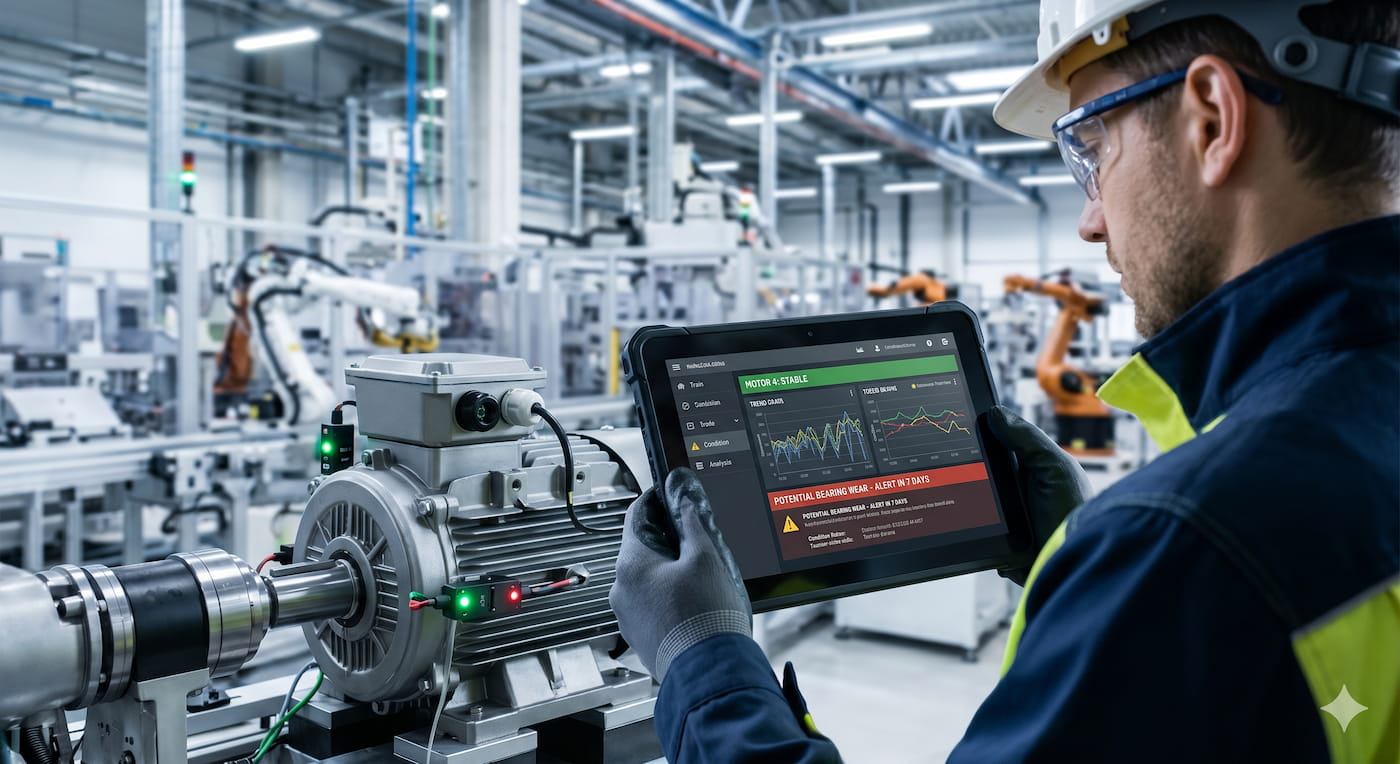
The foundation of any PdM strategy is IoT in maintenance. Modern machinery is outfitted with an array of smart sensors that act as the “nervous system” of the factory. These sensors capture real-time data points such as temperature, pressure, humidity, and power consumption. By integrating predictive maintenance sensors directly onto critical components, companies can achieve a granular level of visibility that was previously impossible.
Condition Monitoring Techniques (Vibration, Thermal, Acoustic)
Once the sensors are in place, they employ various condition-based maintenance (CBM) techniques to “listen” to the health of the machine:
- Vibration Analysis: Detecting misalignments or bearing wear by measuring frequency shifts.
- Thermal Imaging: Identifying “hot spots” that indicate electrical faults or excessive friction.
- Acoustic Monitoring: Using ultrasonic sensors to hear leaks or friction sounds inaudible to the human ear.
Data Analysis and AI: Predicting the Failure
The true magic happens in the digital realm. Raw data is processed using machine learning for maintenance algorithms. These AI models are trained on historical data to recognize the “fingerprint” of a healthy machine versus one heading toward failure. When the data deviates from the norm, the system generates an alert, providing maintenance teams with a window of opportunity to intervene before the breakdown happens.
Predictive vs. Preventive vs. Reactive Maintenance
To understand the value of PdM, one must compare it against older strategies. This comparison is essential for any facility manager looking to optimize their budget.
Feature | Reactive Maintenance | Preventive Maintenance | Predictive Maintenance (PdM) |
Strategy | Fix it when it breaks (Run-to-failure). | Scheduled intervals (Time-based). | Condition-based (Data-driven). |
Cost | High (Emergency repairs/downtime). | Moderate (Labor & part waste). | Low (Optimized intervention). |
Asset Life | Shortened due to stress. | Extended, but parts may be replaced too early. | Maximized based on actual wear. |
Complexity | Low. | Moderate. | High (Requires IoT & AI). |
Best For | Non-critical, cheap parts. | Machines with predictable wear patterns. | Critical, high-value assets. |
Reactive Maintenance: The “Run-to-Failure” Approach
This is the most basic form of maintenance. You use the machine until it stops. While it requires no initial investment in software, the hidden costs are massive: emergency shipping for parts, overtime pay for technicians, and lost production revenue.
Preventive Maintenance: Schedule-Based Checks
The predictive vs preventive maintenance debate often centers on efficiency. Preventive maintenance is like changing your car’s oil every 5,000 miles. It is better than waiting for the engine to seize, but it is often wasteful. Studies show that a large percentage of parts replaced during preventive cycles still have significant remaining life.
Why Predictive Maintenance is Superior?
PdM eliminates the waste of preventive maintenance and the chaos of reactive maintenance. It ensures that every maintenance dollar spent is backed by data. By focusing on the actual condition of the machine, it provides the highest return on investment (ROI) in the long term.
Key Benefits of Implementing Predictive Maintenance
The transition to a PdM model offers several transformative predictive maintenance benefits that impact the bottom line.
Minimizing Unplanned Downtime
Unplanned downtime is the “silent killer” of manufacturing productivity. A single hour of a stopped assembly line can cost hundreds of thousands of dollars. PdM provides early warnings, allowing repairs to be scheduled during planned breaks or slow periods, ensuring the factory stays running when it matters most.
Reducing Maintenance Costs and Spare Parts Inventory
Because you know exactly which part is going to fail and when, you no longer need to keep a massive warehouse of spare parts “just in case.” Just-in-time inventory for maintenance significantly reduces capital tied up in shelving. Furthermore, labor costs are reduced because technicians aren’t performing unnecessary inspections.
Extending Asset Lifespan and Safety
Machines that are kept in optimal condition through PdM experience less “secondary damage.” For example, replacing a worn bearing early prevents the entire shaft from warping. Additionally, PdM enhances workplace safety by preventing catastrophic failures (like boiler explosions or structural collapses) that could endanger employees.
Top Technologies Behind Predictive Maintenance
To build a robust PdM program, several specialized technologies are utilized to extract deep insights from industrial assets.
Vibration Analysis
This is the most common technique for rotating equipment. By analyzing the vibration spectrum, AI can distinguish between a loose bolt, a worn gear, or an imbalanced motor. It is the “gold standard” for early detection in pumps, fans, and turbines.
Infrared Thermography
Heat is almost always a byproduct of inefficiency or friction. Infrared cameras allow technicians to see heat patterns that indicate overloaded circuits, failing insulation, or cooling system blockages without ever touching the equipment.
Oil Analysis and Tribology
By analyzing the microscopic particles found in a machine’s lubricant, engineers can determine the rate of internal wear. Much like a human blood test, oil analysis reveals the “internal health” of engines and gearboxes, identifying contaminants like water, fuel, or metal shavings.
Industries That Benefit Most from PdM
While applicable across many sectors, certain industries have found PdM to be an absolute necessity for survival in 2026.
Manufacturing and Automotive
In high-volume manufacturing, precision is everything. PdM ensures that robotic arms and CNC machines maintain their tolerances. In the automotive sector, PdM prevents bottlenecks in the paint shop or assembly line, where a single motor failure could halt the production of hundreds of vehicles.
Energy, Oil, and Gas
For remote assets like offshore wind turbines or oil rigs, sending a technician is incredibly expensive. PdM allows energy companies to monitor these assets from a central hub and only deploy repair crews when a specific fault is detected, significantly lowering operational costs.
Aviation and Transportation
Safety is the primary driver here. Aircraft engines are equipped with thousands of sensors. PdM allows airlines to swap out components during routine layovers, ensuring that technical delays are minimized and passenger safety is guaranteed.
Future of Maintenance: Prescriptive Analytics
As we look beyond 2026, the industry is moving from predictive to prescriptive analytics. While predictive maintenance tells you when a machine will fail, prescriptive maintenance uses industrial AI to tell you how to fix it or how to adjust operating conditions to delay the failure. For example, the system might suggest slowing down a motor by 10% to ensure it lasts until the next scheduled shutdown.
bEAM Cloud Solutions
The implementation of these high-tech strategies requires a centralized “brain” to manage the data. bEAM Cloud Solutions provide the necessary infrastructure to bridge the gap between IoT sensors and actionable insights. By using a cloud-based Enterprise Asset Management (EAM) system, organizations can synchronize their maintenance schedules, inventory, and real-time sensor data into a single pane of glass. This ensures that the insights generated by AI are immediately translated into work orders, keeping the entire organization aligned.
Frequently Asked Questions About Predictive Maintenance
What is the difference between condition-based and predictive maintenance?
While often used interchangeably, condition-based maintenance (CBM) is a subset of PdM. CBM triggers an alert when a specific threshold is reached (e.g., “The temperature is over 100°C”). Predictive maintenance goes further by using historical data and trends to predict when that threshold will be crossed in the future.
Is predictive maintenance expensive to implement?
The initial setup—including sensors, connectivity, and software—requires an upfront investment. However, most companies see a full return on investment (ROI) within the first 12 to 18 months through reduced downtime and lower repair costs. It is an investment in long-term profitability.
What data is needed for predictive maintenance?
Effective PdM requires three types of data:
- Real-time sensor data (vibration, heat, etc.).
- Historical maintenance logs (past failures and repairs).
- Operational data (speed, load, and ambient conditions).
Can predictive maintenance be used for old machinery?
Yes. Through “retrofitting,” older “dumb” machines can be equipped with external IoT sensors. This allows legacy equipment to be integrated into a modern industrial AI ecosystem, extending the life of older capital assets.


